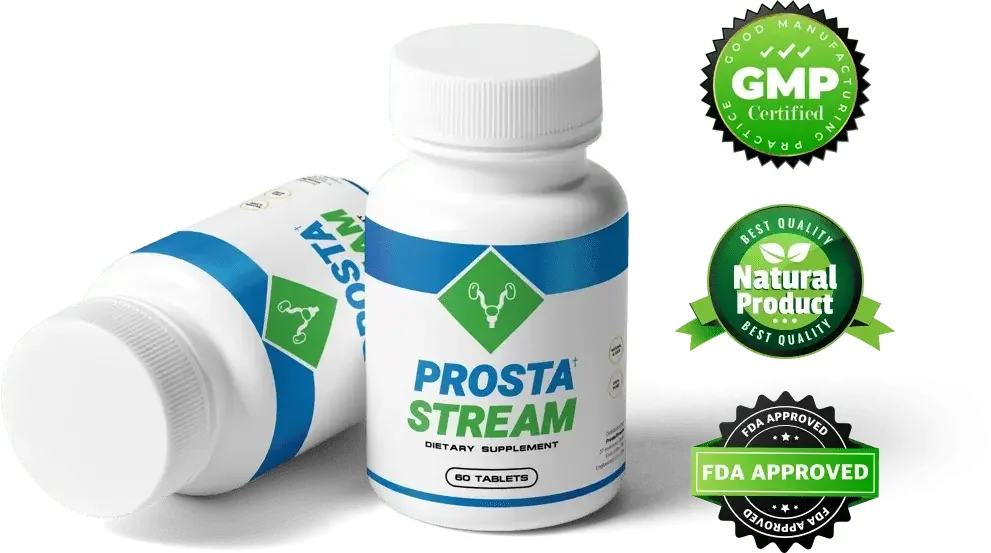
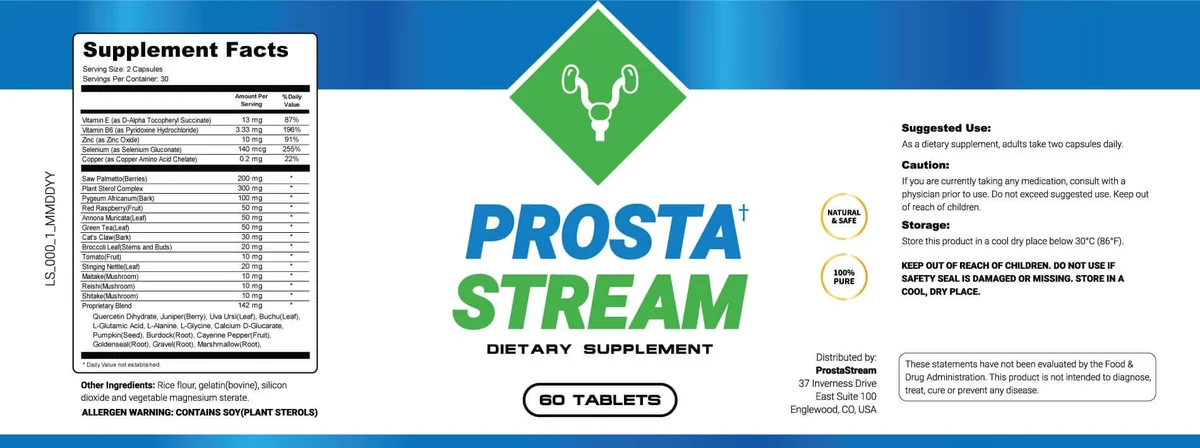
A prostate formula built on saw palmetto, pygeum, beta-sitosterol and a mushroom blend. Here is what each ingredient does, what the largest randomised trials concluded about the lead ingredient, and one fact about PSA testing that every man taking this needs to know.
Check Today’s Price See Packages

Produced in a GMP-compliant US facility.
Maitake, reishi and shiitake alongside the lead botanicals.
Gluten-free, non-GMO, no stimulants.
One-time payment. Returns handled from Aurora, Colorado.
ProstaStream is a herbal prostate support supplement. The makers say they screened 144 ingredients before settling on three leads — saw palmetto berry, graviola leaf and a mushroom blend of maitake, reishi and shiitake — with pygeum africanum, beta-sitosterol, cat's claw, lycopene from tomato, green tea and the minerals zinc, copper and selenium around them.
It is aimed at men noticing the familiar pattern: getting up at night, a weaker stream, or a feeling that the bladder has not quite emptied. Those symptoms are common with age and usually come from benign prostatic hyperplasia — a non-cancerous enlargement.
Two things decide whether this is right for you, and both are covered in full below: what the evidence on saw palmetto really shows, and what taking it does to your PSA reading.
| Product type | Prostate support supplement (capsules) |
| Lead ingredients | Saw palmetto berry, graviola leaf, mushroom blend |
| Also contains | Pygeum africanum, beta-sitosterol, cat's claw, lycopene, green tea |
| Minerals | Zinc, copper, selenium |
| Amounts disclosed | No — read the panel on arrival |
| Realistic timeline | 8–12 weeks of consistent use |
| Critical note | Lowers PSA readings — tell your doctor |
| Guarantee | 60-day money-back · returns to Aurora, Colorado |
Sold through the official website. Every package is a one-time payment — no subscription and nothing to cancel. Multi-bottle bundles bring the per-bottle price down and include free US shipping.

Prices shown were current when this page was last reviewed and are set by the seller. Confirm the package, total, shipping and refund terms on the order page before paying.
The formula works on the two processes most discussed in prostate research: DHT-related hormone activity and ongoing low-grade inflammation.
Saw palmetto and beta-sitosterol are studied for their effect on 5-alpha reductase, the enzyme converting testosterone to DHT. DHT drives prostate tissue growth, which is why prescription drugs for BPH target the same enzyme.
Pygeum, graviola, cat's claw and green tea polyphenols address the low-grade inflammation associated with prostate enlargement and urinary discomfort.
Zinc concentrates in prostate tissue at higher levels than almost anywhere else in the body. Selenium and copper support antioxidant enzymes — and copper matters because zinc depletes it over time.
Each ingredient with what it contributes and where the evidence honestly sits.
The best-known prostate botanical, and the one with the most disappointing large-trial record — the STEP and CAMUS trials both found it no better than placebo. Earlier smaller studies were more positive. It also lowers PSA readings, which is the practical issue covered below.
A plant sterol that has held up more consistently in reviews of lower urinary tract symptoms — on flow rate and symptom scores. If you are buying this formula for one ingredient, the honest answer is this one rather than the saw palmetto on the label.
African cherry bark, used for urinary symptoms for decades and with a more favourable review record than saw palmetto. Anti-inflammatory activity in prostate tissue is the proposed mechanism.
Beta-glucans with immune and antioxidant research behind them. Their prostate-specific evidence is thin — treat this as general support rather than the reason to buy.
Prostate tissue holds zinc at higher concentrations than almost any other tissue, so the rationale is sound. The copper pairing is not optional — sustained zinc depletes copper. Selenium supports antioxidant enzymes.
Antioxidant and anti-inflammatory additions. Lycopene from tomato has some observational prostate association. Graviola (soursop) is worth flagging — long-term high-dose use has been questioned on neurological safety grounds, and the amount here is not published.
Each is a possibility rather than a promise, and none has been demonstrated with the finished product. Curing BPH, shrinking the prostate or preventing cancer are deliberately not on this list — no supplement does any of those.
The outcome men actually care about — though note the high placebo response in this specific symptom area.
Objectively countable, which makes it the most honest thing to track from day one.
Polyphenols from green tea, lycopene and the mushroom blend.
Beta-sitosterol and saw palmetto both act on 5-alpha reductase, the enzyme prescription BPH drugs target.
Zinc concentrates in prostate tissue; selenium and copper support antioxidant enzymes.
Capsules, no stimulants, nothing to time around meals.
Feedback in this category needs reading with care: placebo response for urinary symptoms runs at 30–40% in controlled trials, which is unusually high. The consistent practical themes are a gradual change over 8–12 weeks and the importance of a proper diagnosis first.
“Two or three trips a night was the problem. My GP checked my PSA and did an exam first and said it was benign enlargement. Started this after that. Around ten weeks in it is down to one trip most nights. Whether that is the capsules or the fact I stopped drinking tea after eight, I could not tell you honestly.”
Gerald H., 64 — Pennsylvania
“The thing nobody told me: saw palmetto can lower your PSA number. My urologist spotted it and asked what I was taking. He said it was fine but he needed to know, because a falsely low reading can hide something. Tell your doctor before your test — that is the advice I would give.”
Raymond B., 58 — Ohio
“Read up on it after I bought it and found the big trials on saw palmetto were negative, which was not what the ads implied. That said, the beta-sitosterol and pygeum look better supported and they are in here too. Modest improvement over three months. Four stars for the formula breadth, one off for the marketing.”
Martin D., 61 — Texas
Testimonials are illustrative and not typical. Individual results vary, and no outcome is guaranteed.
Multi-bottle bundles bring the per-bottle price down, with free US shipping and 60 days to change your mind.
One-time payment · No subscription · 60-day money-back guarantee
Sixty days from purchase, which suits this product reasonably — the realistic assessment window is 8 to 12 weeks, so two months gets you most of the way there.
Returns go to an address in Aurora, Colorado. Keep your order confirmation email for the order number, note the deadline in your calendar rather than relying on memory, and start any return with time to spare — deadlines are measured at the seller's end and transit time is not always counted in your favour.
Urinary symptoms have several causes, and only some are benign. A PSA test and examination cost far less than six bottles and tell you something a supplement never will.
Saw palmetto lowers PSA readings. A falsely low result can delay detection of something serious. This is the single most important step on this page.
Where current pricing and the 60-day guarantee apply, with returns handled from Aurora, Colorado.
That is the realistic window, and night-time trips per week is the one measure you can track honestly.
Secure your ProstaStream package while stocks last. Official website only, one-time payment, with free US shipping on multi-bottle bundles.

ProstaStream is a herbal prostate support supplement in capsule form. The makers say 144 ingredients were screened before settling on saw palmetto berry, graviola leaf and a maitake/reishi/shiitake mushroom blend as the leads, with pygeum africanum, beta-sitosterol, cat's claw, lycopene, green tea and the minerals zinc, copper and selenium around them. It is gluten-free, non-GMO and stimulant-free, made in a GMP facility in the USA.
On two processes central to prostate research. Saw palmetto and beta-sitosterol act on 5-alpha reductase, the enzyme that converts testosterone to DHT — the hormone driving prostate tissue growth, and the same target as prescription BPH drugs. Pygeum, graviola, cat's claw and green tea address low-grade inflammation. Zinc, which concentrates in prostate tissue more than almost anywhere else in the body, supports normal function.
Here is the honest position. The two largest randomised trials of saw palmetto — STEP in the New England Journal of Medicine and CAMUS in JAMA — found it no better than placebo for urinary symptoms, even at triple dose. Beta-sitosterol and pygeum, both also in this formula, have held up better in reviews. The finished product has not been trialled. Expect modest support at best, and note that placebo response in urinary symptom trials runs at an unusually high 30–40%.
Yes, and this matters more than anything else on this page. Saw palmetto can lower PSA readings. PSA is one of the main screening tools for prostate cancer, and a falsely low result can delay detection. Tell your doctor you are taking this before any PSA test. That single sentence protects you; not saying it does not.
No, and pages claiming otherwise are making illegal disease claims. No dietary supplement is permitted to claim it cures benign prostatic hyperplasia or prevents prostate cancer, and none has been shown to. Some pages selling this product use exactly that language, which should make you more cautious about their other claims rather than less.
Saw palmetto berry, graviola leaf, a mushroom blend of maitake, reishi and shiitake, pygeum africanum bark, beta-sitosterol, cat's claw, lycopene from tomato, green tea, and the minerals zinc, copper and selenium. Individual amounts are not published — read the Supplement Facts panel when your order arrives.
Eight to twelve weeks of consistent use is the realistic window, and judging it after a few days tells you nothing. Track night-time bathroom trips per week from day one — it is countable, objective, and far more reliable than how you feel on a given morning.
Pricing follows the standard tiered structure: around $69 for a single bottle, roughly $59 per bottle on the three-bottle package and about $49 per bottle on the six-bottle package. Larger bundles include free US shipping. One-time payments with no subscription. Confirm at checkout, since prices change.
Generally well tolerated. Mild digestive upset is the usual complaint. Saw palmetto has mild antiplatelet activity, so it matters if you take an anticoagulant or have a bleeding disorder. Graviola is worth a specific mention — long-term high-dose use has been questioned on neurological safety grounds, and the amount in this blend is not published. Men allergic to plants in the Asteraceae family should check the label.
Check with your doctor or pharmacist first. The specific concerns are 5-alpha reductase inhibitors such as finasteride or dutasteride, where the mechanisms overlap and your doctor needs to know; anticoagulants, because saw palmetto has mild antiplatelet activity; and any medication where you are also monitoring PSA.
No. No dietary supplement is FDA approved — supplements are regulated as food, without pre-market review of whether they work. Manufacturing in a GMP-compliant facility describes production standards, not approval of the product or its claims.
Through the official website, where current pricing and the 60-day guarantee apply and returns are handled from an address in Aurora, Colorado. Buying elsewhere means no guarantee and no way to verify the batch or expiry.
Real, verifiable PubMed records — including the two largest saw palmetto trials, which reported negative results.
Regular Price: $99/per bottleToday: $49/per bottle
On the 6-bottle package · Free US shipping · 60-day money-back guarantee
Get Your Discount NowOne-time payment · No subscription · 60-day money-back guarantee
The four things that decide it, side by side.
A genuinely wide formula — beta-sitosterol and pygeum are both in here, and both have held up better in reviews than the headline ingredient.
The two largest saw palmetto trials found no benefit over placebo. That is the ingredient the marketing leans on hardest.
Saw palmetto lowers PSA readings. Tell your doctor before a test — a falsely low result can delay a serious diagnosis.
Urinary symptom trials show 30–40% placebo response. Individual testimonials, including good ones, cannot settle this.
The verdict — 4.8/5: a broad, reasonably built prostate formula whose best ingredients are not the ones on the poster. Beta-sitosterol and pygeum carry more convincing evidence for urinary symptoms than the saw palmetto the marketing leads with, and both are included. Worth considering if a doctor has confirmed your symptoms are benign, you understand the timeline is 8 to 12 weeks, and you tell whoever orders your PSA test that you are taking it. Not worth considering as a substitute for getting checked — prostate cancer and BPH feel the same early on, and only one of them is harmless.